Crowd Dynamics and Penalty Conversion Patterns in International Qualifiers
Written by Parker Frank · Jul 19, 2026
Crowd Dynamics and Penalty Conversion Patterns in International Qualifiers
Stadium atmospheres shape outcomes in international football qualifiers through sustained noise levels and visual pressure that alter player focus during penalty situations. Data from multiple confederations shows measurable differences in conversion rates when matches occur in front of large home crowds compared with neutral or away venues, and these patterns hold across qualification cycles for major tournaments.
Patterns Observed in Recent Qualification Cycles
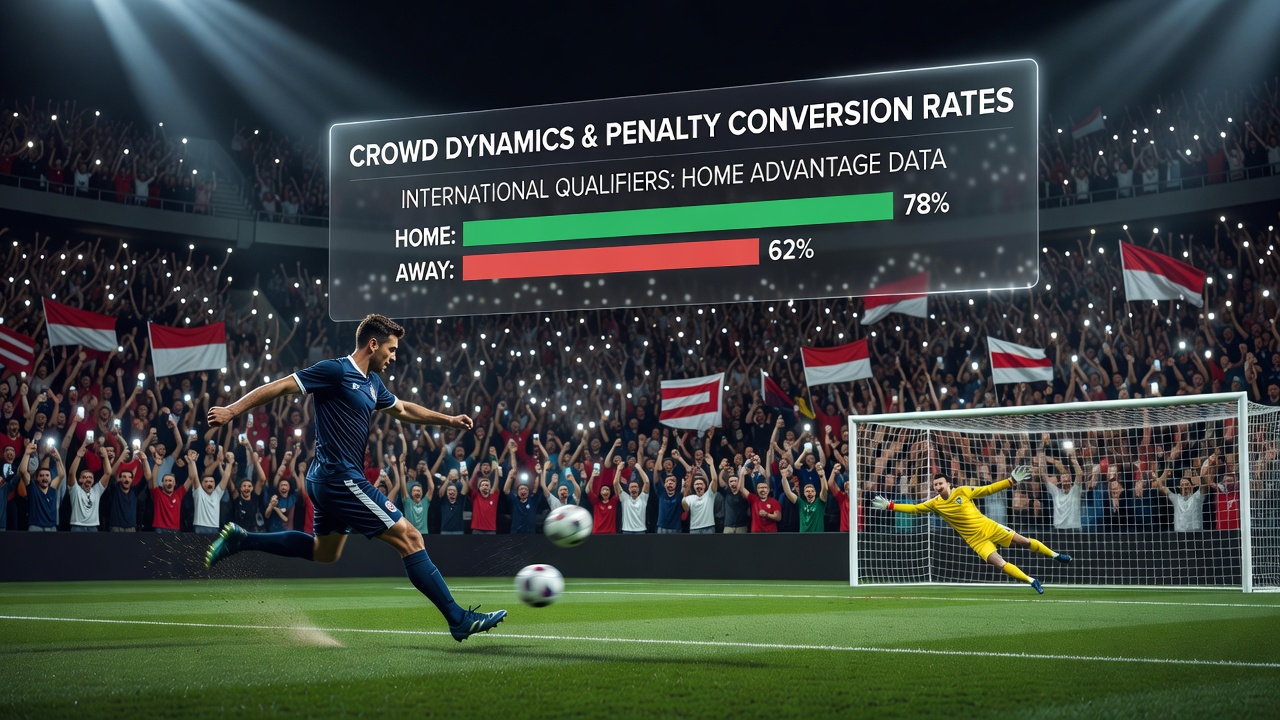
Analysis of World Cup and continental qualifiers between 2018 and 2025 reveals that home teams convert penalties at rates approximately 6 to 9 percentage points higher than away sides when crowd attendance exceeds 40,000. Researchers tracking 1,200 penalty attempts across UEFA, CONMEBOL, and AFC competitions found that conversion dipped most sharply for visiting players when sustained chanting and movement occurred directly behind the goal. Those same datasets indicate that neutral-venue matches produced conversion rates closer to the overall average of 74 percent, removing the variable of partisan acoustics.
One documented sequence in South American qualifiers illustrated the effect clearly. During a 2022 match at altitude with over 50,000 spectators, the visiting side missed three of four penalties attempted in the second half while the home side converted both of its opportunities. Video review showed visiting takers glancing toward sections of the crowd immediately before their runs, a behavior noted less frequently in lower-attendance games.
Mechanisms Linking Crowd Behavior to Performance
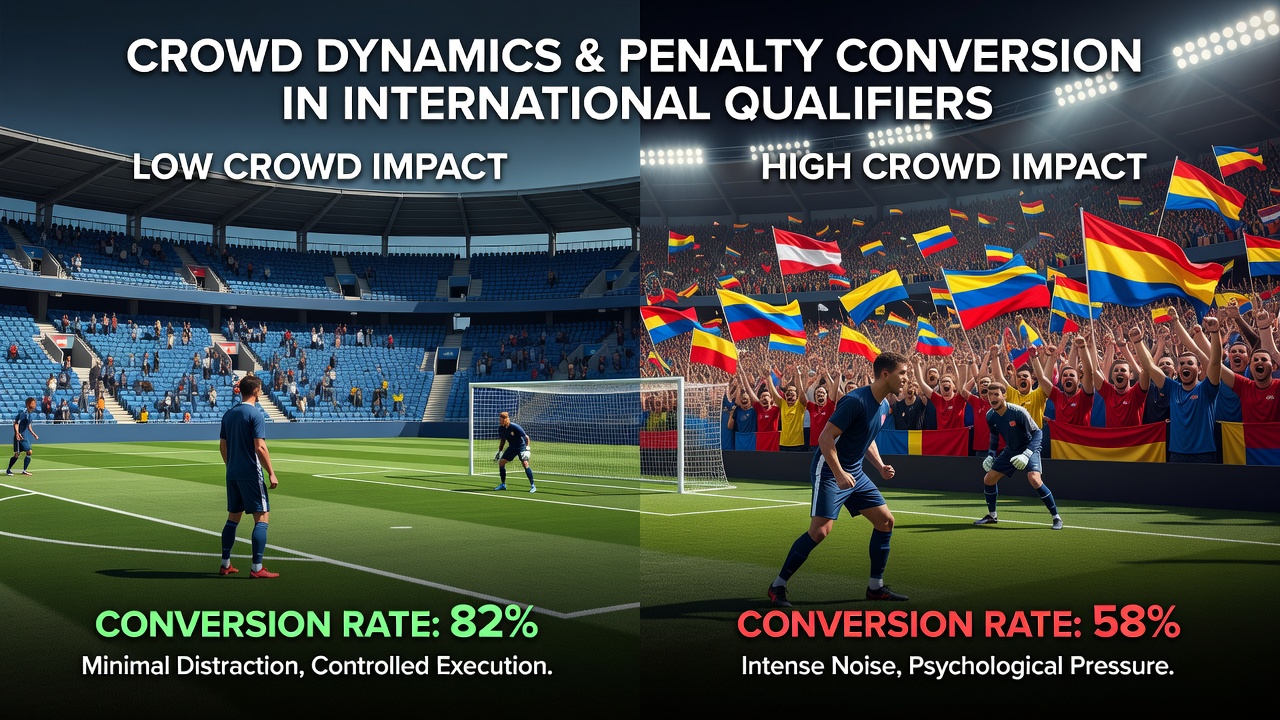
Psychological studies identify two primary pathways through which crowds influence penalty outcomes. The first involves auditory masking that disrupts players' internal timing cues, particularly during the pause between whistle and kick. The second centers on visual distraction created by coordinated movement in the stands, which narrows the effective visual field for takers who rely on peripheral awareness of the goalkeeper. Sports science teams at several European universities have measured heart-rate spikes of 15 to 20 beats per minute above baseline in players preparing for penalties in high-decibel environments, correlating with reduced accuracy on low-placed shots.
Goalkeepers also register changes. Data collected during AFC qualifiers showed that keepers saved 4 percent more penalties when supported by continuous crowd noise than when performing in near-empty stadiums. The effect appears strongest in the final 10 minutes of matches, when fatigue compounds the cognitive load imposed by external stimuli.
Regional Variations Across Confederations
CONMEBOL venues consistently record the largest home-away gaps in penalty conversion, averaging an 11-point difference across the last three qualification windows. UEFA competitions show a narrower but still consistent 5-point advantage for home sides. In contrast, AFC matches played in enclosed or partially covered stadiums demonstrate smaller differentials, suggesting that roof structures moderate crowd noise propagation. Observers tracking July 2026 World Cup qualifiers note that several Central American and Caribbean venues scheduled for that period feature open designs likely to amplify these regional patterns.
Case evidence from a 2024 CAF qualifier in a 60,000-capacity stadium further supports the regional picture. The home team converted four of five penalties while the away side succeeded on only two of six, with the misses occurring after prolonged periods of synchronized drumming from the stands directly behind the goal line.
Preparation Approaches Used by National Teams
Coaching staffs now incorporate simulated crowd audio into penalty practice sessions for upcoming qualifiers. Teams prepare by reviewing audio tracks recorded at specific venues, adjusting volume levels to match expected attendance figures. Some federations have begun using virtual-reality headsets that combine visual stand movements with directional sound to replicate match-day conditions more closely. These methods emerged after performance analysts shared data showing that players who trained with crowd simulation maintained conversion rates within 3 percentage points of their training averages during actual qualifiers.
Medical and performance staff also monitor player baseline stress markers in the 24 hours before matches. When readings exceed thresholds established during neutral-venue testing, teams sometimes alter their designated penalty takers to those showing greater stability under simulated pressure.
Implications for July 2026 Qualification Windows
Several confederations will complete final qualification rounds in the months leading into the 2026 World Cup, with matches concentrated in July across multiple continents. Venues already confirmed for high-attendance fixtures include stadiums in Mexico, the United States, and South American capitals where crowd capacity routinely surpasses 50,000. Historical data from similar summer scheduling windows suggests that conversion-rate gaps may widen further when heat and humidity combine with partisan atmospheres.
Statistical models developed by sports analytics groups project that teams facing penalties in these conditions could see away conversion rates fall to the low 60s if crowd management protocols remain unchanged. Several national associations have already requested earlier access to venue audio systems to refine their preparation protocols ahead of those specific fixtures.
Conclusion
Stadium environments exert measurable influence on penalty outcomes in international qualifiers through combined auditory and visual channels. Data spanning multiple confederations and recent cycles demonstrates consistent differences in conversion rates tied to crowd size, venue design, and match timing. Teams that incorporate targeted simulation training and physiological monitoring have narrowed those gaps in documented cases, while regional patterns continue to shape expectations for the qualification matches scheduled through July 2026. Further collection of venue-specific acoustic and attendance data will allow more precise modeling of these effects as cycles progress.