Safety Car Periods Reshaping Overtake Prop Chains During Formula One Monsoon Grands Prix
Written by Blake Butler · Jul 26, 2026

Safety Car Periods Reshaping Overtake Prop Chains During Formula One Monsoon Grands Prix
Formula One safety car deployments during monsoon conditions create distinct patterns in overtake statistics that directly influence prop betting markets across multiple Grands Prix. Data collected from wet-weather races shows safety cars bunch the field into a compressed train, which then produces elevated overtake attempts once racing resumes under green flags, and this sequence repeats when rain intensifies again later in the same event.
Mechanics of Safety Car Deployment in Heavy Rain
Race directors activate the safety car when visibility drops below thresholds established by the FIA, and monsoon events in Southeast Asia and Japan trigger these calls more frequently than dry European rounds because standing water and spray reduce sightlines to critical levels. Once the safety car enters the track, lapped cars receive permission to unlap themselves under specific regulations introduced in recent seasons, which alters the order of cars rejoining the queue and changes the starting positions for the restart wave that follows.
Teams respond by switching tire compounds during the safety car window, and wet-weather data indicates that drivers on intermediate tires often gain positions on restarts while those remaining on full wets lose grip as the track begins to dry. These tire choices create measurable spikes in position changes that betting analysts track when constructing overtake prop chains for individual drivers or entire fields.
Historical Patterns from Monsoon Races
Records from the Malaysian Grand Prix between 2001 and 2017 reveal that safety car periods preceded an average of 18 additional overtakes per race compared with dry conditions, while the Japanese Grand Prix at Suzuka shows similar spikes when typhoon remnants bring prolonged rain. Observers tracking lap-by-lap telemetry note that the majority of these passes occur within the first three laps after each restart, because drivers exploit the clean air and warmer tires that result from following the safety car closely.
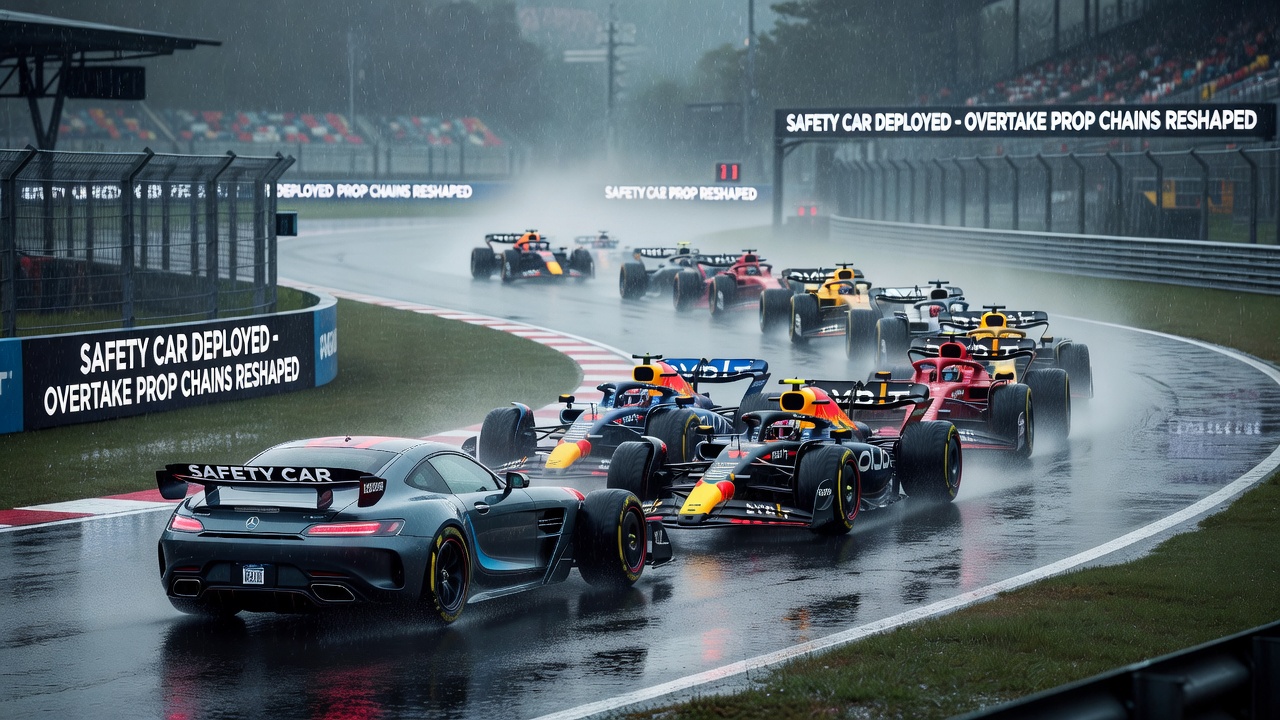
Statistical models built from these events demonstrate that overtake frequency rises sharply in the sector immediately after the safety car pits, and the effect compounds when multiple deployments occur within one race. Researchers at the Fédération Internationale de l'Automobile have documented how virtual safety car periods, introduced as a complement to the physical car, produce smaller but still significant overtake clusters because they allow teams to make pit stops without losing as much time.
Effects on Prop Betting Markets
Betting operators adjust overtake props when forecasts indicate heavy rain because historical chains show that safety car restarts reliably increase the total number of passes by 25 to 40 percent in affected races. Prop chains linking multiple drivers become more complex as the safety car resets gaps, and analysts examine past monsoon data to set lines for drivers who historically gain places on wet restarts such as those with strong traction control calibration or superior intermediate tire management.
Live betting markets react within seconds of a safety car deployment, and figures from European motorsport data providers indicate that prop volumes on overtake counts rise by factors of three to five during these windows. The same data shows that certain circuits amplify the effect because their layout features long straights and heavy braking zones where position changes concentrate after the field accelerates from the safety car speed.
Developments Expected Through 2026
Regulatory adjustments scheduled for the 2026 power unit cycle retain the current safety car protocols while introducing new aerodynamic packages that may alter how quickly cars can follow through spray, yet the core dynamic of bunching followed by restart overtakes remains unchanged according to simulations released by the FIA. Events planned for July 2026 continue the established pattern of monsoon-affected rounds in Asia, where forecasters anticipate repeated safety car interventions that will again reshape overtake prop availability in the same manner observed in prior seasons.
Telemetry archives confirm that drivers starting from even positions behind the safety car line achieve higher overtake success rates than those further back, and this positional data feeds directly into updated prop models used by market makers. Teams have begun publishing sector-time statistics that separate wet-restart performance, allowing more precise calibration of expected position gains when rain returns during the second half of a race.
Conclusion
Safety car periods in Formula One monsoon Grands Prix consistently produce elevated overtake volumes that propagate through prop betting structures, and the documented patterns from multiple circuits provide the factual basis for market adjustments. Data collected across decades of wet-weather events shows these interventions create repeatable chains of position changes that operators incorporate into lines, while regulatory continuity through 2026 preserves the same underlying mechanics for future analysis.